Uploading
To upload files and metadata to o/DAILIES, use our o/DAILIES/MANAGER for macOS.
On the settings page, please define a watch folder where a directory structure for all your projects is created. The app runs in the background and detects new files in that folder.
Additionally, if you use
Directory layout
After the completed setup, a folder structure will be generated for you if you are a Dailies Manager already. For every project you have access to, which has a valid subscription, a folder will be created. If the folder for newly created project is missing, please restart o/DAILIES/MANAGER. The structure may look like this:
/Users/<your_username>/Documents/odailies/
├── Project A
│   ├── _audio      # Replacement audio tracks (.m4a) for existing clips
│   ├── _bins       # Beta feature - only appears if enabled
│   ├── _done
│   ├── _error
│   ├── _graded
│   ├── _log
│   ├── _still
│   ├── _transfers  # Beta feature - only appears if enabled
└── Project B
    ├── _audio      # Replacement audio tracks (.m4a) for existing clips
    ├── _bins       # Beta feature - only appears if enabled
    ├── _done
    ├── _error
    ├── _graded
    ├── _log
    ├── _still
    └── _transfers  # Beta feature - only appears if enabled
Tip
For the o/DAILIES/MANAGER to create a folder structure, a project must
- have a valid subscription attached
- or be a workflow demo
Local file handling
Transcode your dailies with the correct file specs directly into your project folder.
_graded
All your graded dailies clips belong in the folder _graded.
_done
The o/DAILIES/MANAGER picks up the files, uploads them and moves them to the folder _done.
You are free to remove them from here, but we recommend keeping them around.
_error
If something was wrong with any file, you'll find it instead moved to the folder _error.
_log
Optionally, you can upload LOG variants of the same clips in a folder named _log.
Users with the "Advanced Video options" permission are now able
to switch video sources on-the-fly.
_still
Optionally, you can upload still images extracted from your clips in a folder named _still.
See the Stills (Beta) page for details on this feature.
This feature is currently in beta and available by request only.
_bins
The _bins folder is for uploading and organizing additional clips that don't originate from principal photography, such as content from editorial or VFX departments.
This folder only appears after the Bins (Beta) feature is enabled for your project.
Create subfolders within _bins to organize your content by category or department.
You can also drop an .edl file next to a cut you upload here. o/DAILIES links the cut back to the original camera clips, so you can jump from the cut to the take that was used and compare it against the other takes. See Matchback.
See the Bins (Beta) page for complete details on this beta feature.
_audio
Drop a .m4a file here whose basename matches an existing clip's name to replace that clip's audio track without re-uploading the video. The replacement is processed server-side: the existing video is remuxed with the new audio, and the clip is republished at a fresh URL so caches refresh automatically.
The file must be AAC, stereo (2 channels), in an MP4 container with a .m4a extension, and its duration must match the clip's video duration exactly.
Example: to replace the audio of a clip named A001C001_260422_R3CK, drop _audio/A001C001_260422_R3CK.m4a into the project folder.
ALE files
If your project is not linked to a Silverstack library, upload an ALE file for metadata by placing it in the root project folder (inside your watch-folder project directory). To update metadata, upload a new ALE the same way.
If your project is linked to Silverstack (Silverstack Link), live metadata still comes from Silverstack while o/DAILIES/MANAGER is running. Dropping an ALE does not disable that link or replace it as the primary source. To use only ALE for metadata, the Silverstack association must be removed by support—see Using ALE instead of live Silverstack sync.
Info
After the upload, o/DAILIES automatically post-processes your footage for a better user experience.
File specs
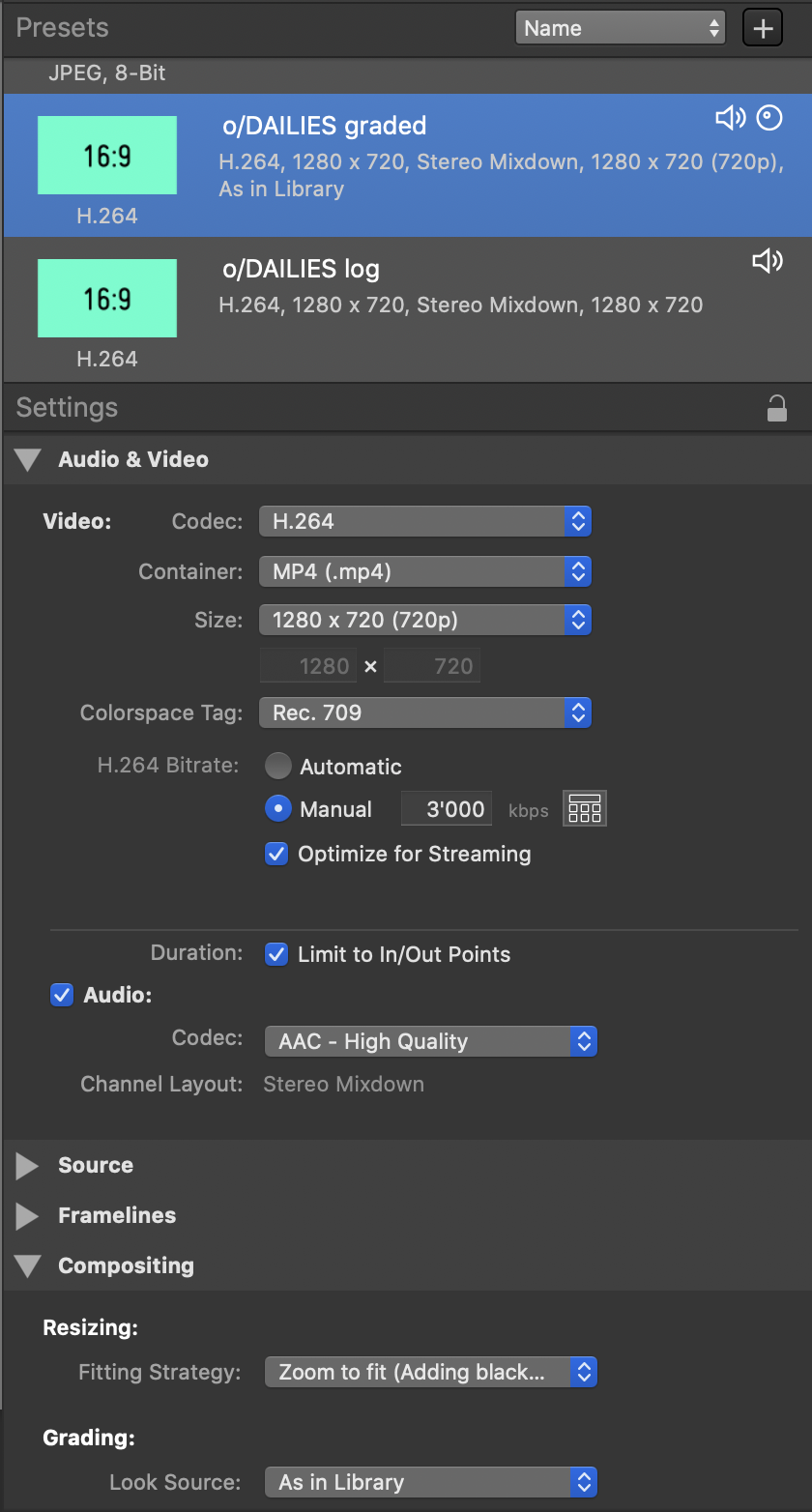
Make sure that the files match the following criteria:
| Setting | Value |
|---|---|
| Video Codec | H.264 or HEVC (H.265) for better compression * |
| Audio Codec | AAC |
| Audio Channels | 2 |
| Container | MP4 with .mp4 ending |
| Optimization | Streaming Optimized (moov atom at start) |
| Resolution | 1280x720 (720p) recommended but not enforced * |
| Bitrate | 2 - 6 Mbit recommended but not enforced * |
Info
* To give you full control over the encoding quality of the delivered clips we do not re-encode them. Don't push the bitrate or resolution too high as we do not create smaller versions. Your users with poor internet connections will thank you.
Info
Replacement audio uploads in _audio follow the same audio rules (AAC, 2 channels) and additionally must match the existing clip's duration exactly.
Video Codec
The video codec should be set to H.264 for optimal compatibility. HEVC (H.265) offers better compression and is now supported by all major browsers including Firefox. However, older devices may lack hardware decoding capabilities for HEVC. If you're certain all your users have modern devices, you can use HEVC for improved efficiency and smaller file sizes.
Hopefully we can switch to open codecs like AV1 in the future.
Streaming Optimized
MP4 files should be optimized for streaming (also known as "fast start" or "web optimized"). This means the MP4 container's metadata (moov atom) must be placed at the beginning of the file. Most encoding software has an option for this, often called:
- "Fast Start" (FFmpeg)
- "Optimize for Streaming" (Silverstack)
- "Network Optimization" (DaVinci Resolve)
DaVinci Resolve example config
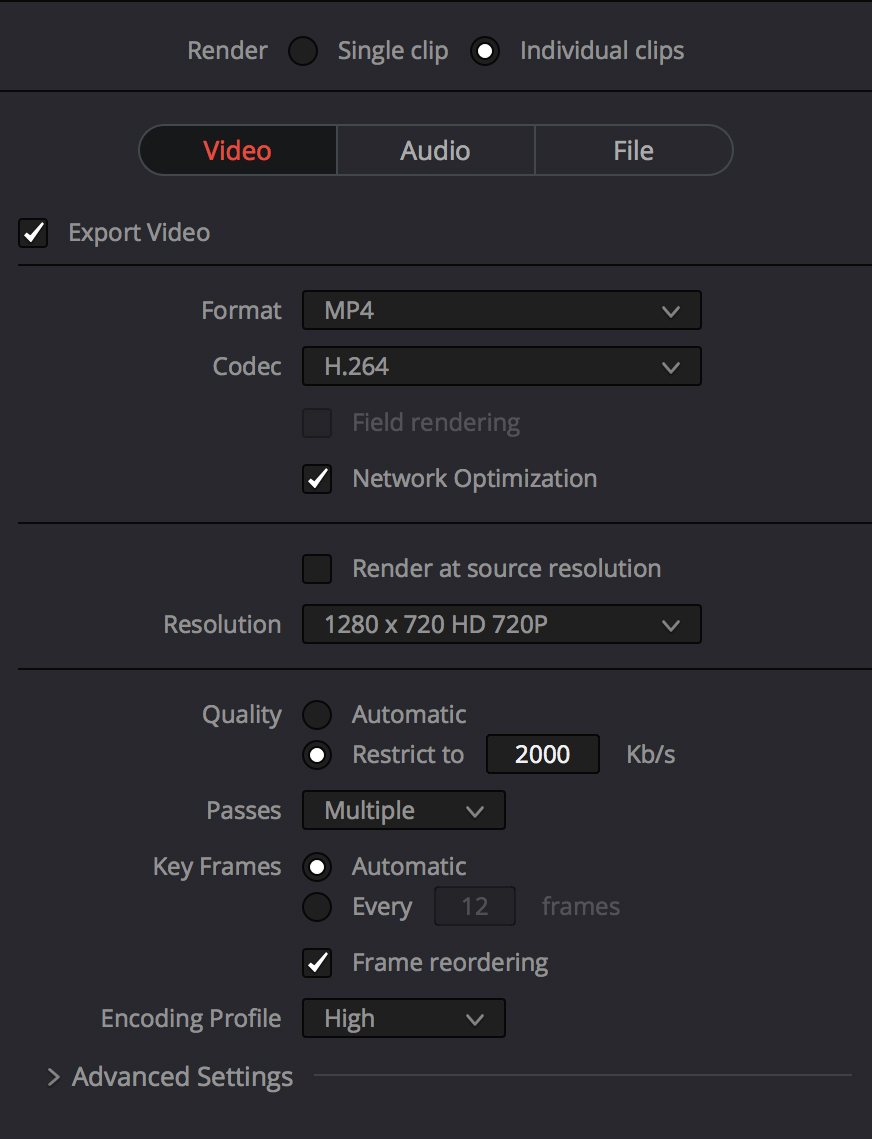
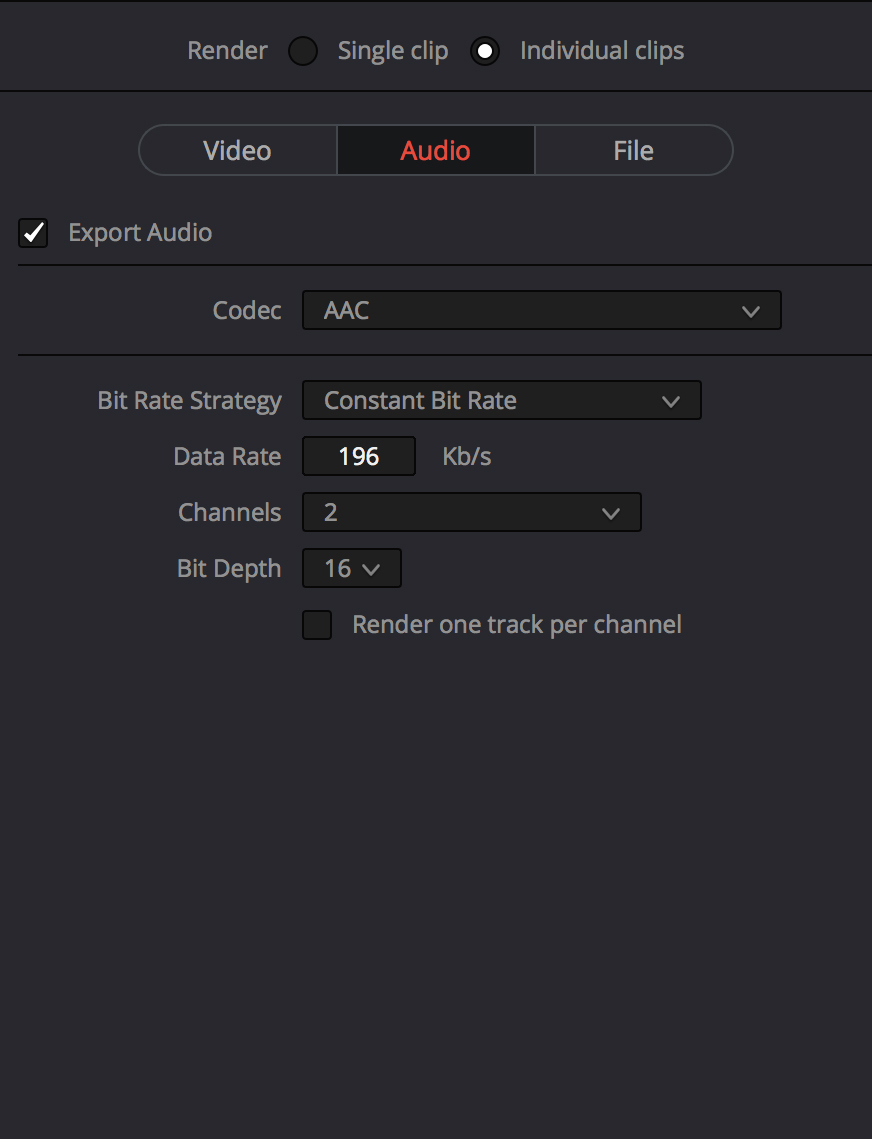
Silverstack example config
Switching workstations
Files
You can upload files from multiple workstations at once. It is quite common to finish uploading from a personal MacBook at the hotel for example.
Silverstack Link
Silverstack live sync can only hold the machine lock on one Mac at a time. The Migrate Silverstack action clears that lock for a planned move to another computer; it does not by itself stop Silverstack metadata on the same machine—see Association vs machine lock.
Transfers (Beta)
Beta Feature
The transfer feature is currently in beta and available by request only. To have this feature enabled for your project, please reach out through our live chat support (click the chat icon in the bottom right corner) or email us at odailies@ottomatic.io.
Files placed in the _transfers folder are distributed to the editorial machines
enabled on the project's Transfers page. Organize the files into folders,
typically one per shooting day; the receiving machines mirror the same folder
structure, and a file placed directly in _transfers is moved to _error.
Downloads on a receiving machine start paused: after an admin enables the
machine, its user resumes downloading with the switch in the Downloads
section of the Transfers page, so enabling a machine never consumes its
bandwidth unannounced. Resuming first asks to confirm the download folder,
which can be changed on the spot; the folder is shared by all projects, and
each project creates its own subfolder inside it. The sending machine has a
matching pause control on
the upload queue for times when the connection is too poor to spend on
transfer files; while paused, transfer files keep queueing and upload after
resuming, and dailies uploads continue unaffected.
The folder accepts exactly the formats an editorial handoff needs; anything
else is moved to _error with a note explaining why:
- Editing proxies: Apple ProRes 422 Proxy or LT (
.movor.mxf), and DNxHD 36 up to 145 or DNxHR LB/SQ in OP-Atom.mxf. - Sound: uncompressed Broadcast Wave (
.wav), mono or poly, and uncompressed PCM audio in OP-Atom.mxf. - Editorial metadata:
.ale,.avb,.xml, and.edlfiles.
Metadata formats are uploaded ahead of large media so editors receive updated bins and edits first. Transfer media never delays your dailies: proxies and sound upload after everything else in the queue, except LOG variants, which always upload last.
When a folder's content is final, mark it as complete on the project's Transfers page (the lock on the folder's card). You can do this while files are still uploading: receiving machines immediately see the folder's final file count and get a completed check mark once everything has arrived. Files added to a completed folder are not uploaded; the Transfers page shows them as held back until you reopen the folder.
Transfer files are encrypted on the sending machine before they are uploaded and decrypted on the receiving machines after download, so transfer storage only ever holds encrypted content. Every file's integrity is verified as it is decrypted: a corrupted or tampered download is rejected and retried instead of landing in the editorial folder, and an incomplete download never appears at the destination path.
Transfer storage is a staging area, not an archive. A file is removed from it
as soon as every authorized machine has downloaded it, and at the latest 4
days after upload. A machine that is authorized after a file was removed does
not receive it automatically; to send it again, move the file from _done
back into _transfers.
Tip
As this is a beta feature, we welcome your feedback and suggestions for improvement. Please share your experience through our support channels.